

For DTC brands, choosing between Google Ads and Facebook Ads is not just a media-buying decision. It directly affects customer acquisition cost, cash flow, inventory movement, creative workload, and long-term profitability.
Both platforms can drive sales. Both can waste a budget. And both can look profitable in dashboards while quietly hurting your margins if you are tracking the wrong numbers.
The real question is not, “Which platform is better?”
The better question is:
Which platform can bring the right customer at the right cost, at the right stage of your DTC growth journey?
Google Ads and Facebook Ads work very differently. Google captures demand that already exists. Facebook, through Meta’s ad ecosystem, creates demand by putting your product in front of people before they search for it. For DTC brands, that difference matters because customers rarely move from first impression to purchase in one straight line.
A shopper might discover your skincare product on Instagram, visit your website, leave, search your brand name on Google two days later, compare reviews, click a Shopping ad, and finally buy after seeing a retargeting ad. If you judge each platform in isolation, you may underinvest in the channel that drove the sale or overcredit the channel that merely closed it.
This guide breaks down how Google Ads and Facebook Ads compare for DTC brands, where each platform performs best, and how to decide which one deserves more of your budget.
What Are Google Ads and Facebook Ads?
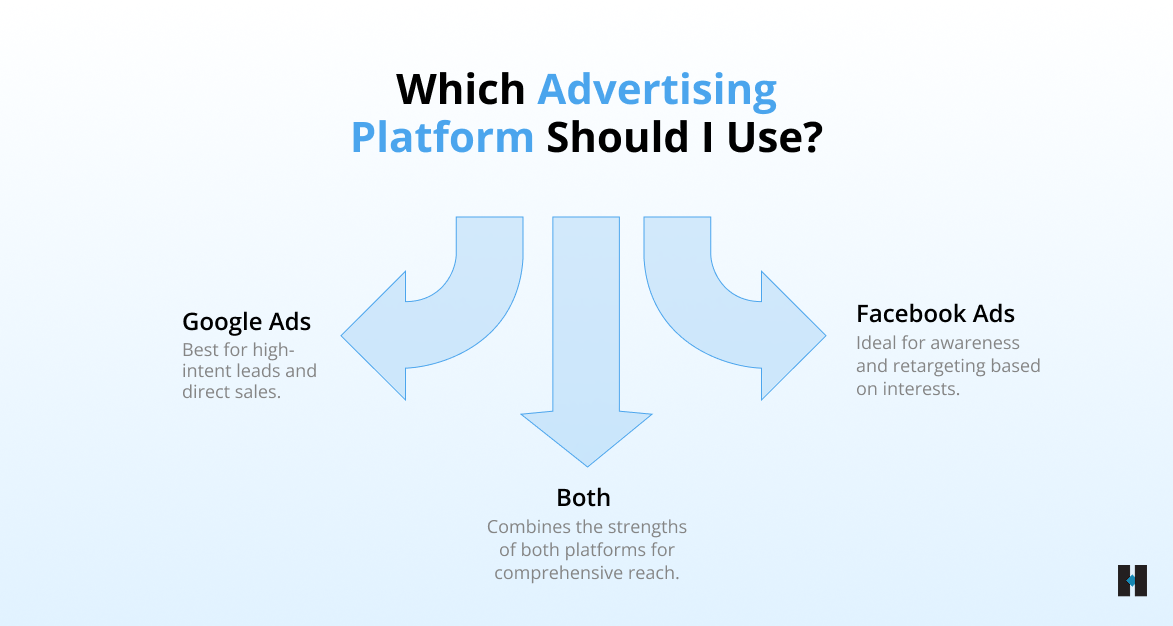
Before comparing ROI, it is important to understand how each platform works.
Google Ads is built around intent. It allows brands to show ads when people search for products, problems, comparisons, or brand names. For ecommerce brands, this includes Search ads, Shopping ads, Performance Max, YouTube, Display, Gmail, Discover, and Maps. Google’s Performance Max campaigns are designed to use a single campaign to reach multiple Google channels, including Search, YouTube, Display, Discover, Gmail, and Maps.
For a DTC brand, Google Ads often works best when shoppers already know what they want. Someone searching “best vegan protein powder,” “buy red light therapy mask,” or “non-toxic cookware set” is already showing purchase intent.
Facebook Ads, often referred to today as Meta Ads, include placements across Facebook, Instagram, Messenger, Reels, Stories, and other Meta inventory. Meta’s strength is not search intent. Its strength is discovery, visual storytelling, and audience building. Meta reported an average of 3.56 billion Family daily active people in March 2026, underscoring the scale available across its apps.
For DTC brands, Meta is often where customers first notice the product. A strong product demo, founder story, customer testimonial, UGC video, or before-and-after creative can create demand even when the shopper was not actively looking.
In simple terms:
Google Ads helps you capture demand. Facebook Ads helps you create and shape demand.
That is the foundation of the ROI discussion.
Key Differences Between Google Ads and Facebook Ads for DTC Brands
| Category | Google Ads | Facebook Ads / Meta Ads |
| Main strength | Captures high-intent shoppers | Builds awareness and demand |
| User mindset | Actively searching | Scrolling, watching, discovering |
| Best DTC use case | Shopping, branded search, category search, competitor terms | Product discovery, creative testing, retargeting, lifestyle storytelling |
| Creative dependency | Medium | Very high |
| Speed to purchase | Often faster | Often longer unless the offer is strong |
| CPC tendency | Usually higher for competitive searches | Often lower, but conversion intent varies |
| Best funnel stage | Bottom and middle of the funnel | Top, middle, and retargeting |
| Main risk | Expensive clicks, limited scale, heavy competition | Creative fatigue, attribution gaps, low-intent traffic |
| ROI driver | Search intent + product feed quality | Creative quality + audience-message fit |
For DTC, this difference is critical. You are not just trying to get traffic. You are trying to buy customers profitably.
A brand with a $45 average order value cannot afford the same acquisition cost as a brand with a $220 average order value and repeat purchases. A brand selling a new product category may need Meta to educate the market. A brand selling a product people already search for may see faster returns from Google Shopping and Search.
The right platform depends on product awareness, category demand, margins, repeat purchase rate, and how much education your customer needs before buying.
Google Ads vs Facebook Ads Across the Sales Funnel
Google Ads and Facebook Ads do not play the same role in the customer journey. Google is strongest when people already know what they want and are actively searching for it. Facebook is stronger when people are still discovering products, learning about problems, or getting familiar with a brand.
For DTC brands, the right question is not “Which platform is better?” The better question is “Which platform works better at each stage of the funnel?”
| Funnel Stage | Customer Mindset | Google Ads Role | Facebook Ads Role | |
|---|---|---|---|---|
| Top of Funnel | “I may not know this product exists yet.” | Helps with YouTube, Display, Demand Gen, and Performance Max awareness | Strong for discovery, storytelling, visual ads, and demand creation | |
| Middle of Funnel | “I am comparing options.” | Captures searches like “best,” “reviews,” “near me,” or product category keywords | Retargets engaged users with reviews, benefits, FAQs, and product education | |
| Bottom of Funnel | “I am ready to buy.” | Strong for Search, Shopping, branded search, and high-intent keywords | Strong for cart recovery, offer reminders, and dynamic product retargeting | |
| Post-Purchase | “Should I buy again?” | Supports branded searches and repeat product searches | Strong for upsells, cross-sells, loyalty campaigns, and new launches |
1. Building Awareness at the Top of the Funnel
At the top of the funnel, customers are not always looking for your product. They may be scrolling through Instagram, watching Reels, or browsing content without any buying intent.
This is where Facebook Ads usually perform better.
Facebook and Instagram are discovery-based platforms. They help DTC brands introduce products through visuals, lifestyle content, UGC-style videos, founder-led videos, before-and-after creatives, problem-solution ads, and educational content.
For example, a skincare brand can show an ad about dull skin, acne, or daily skincare routines before the customer searches for a product. A home fitness brand can show a video explaining how people can work out at home without expensive equipment.
Google can also support awareness through YouTube, Display, Demand Gen, and Performance Max campaigns. But when it comes to visually creating demand, Facebook often gives DTC brands more control over the story.
| Best for Awareness | Why |
|---|---|
| Facebook Ads | Better for product discovery, scroll-stopping creatives, and visual storytelling |
| Google Ads | Useful for YouTube, Display, and wider reach, but less direct for cold discovery |
2. Building Consideration in the Middle of the Funnel
In the middle of the funnel, customers are interested but not ready to buy immediately. They may visit your website, check product pages, compare prices, read reviews, or look for alternatives.
At this stage, both Google Ads and Facebook Ads are useful.
Google Ads works well when people start searching with comparison or research intent. For example:
| Search Intent | Example Keyword |
|---|---|
| Comparison | “Google Ads vs Facebook Ads for ecommerce” |
| Product research | “best LED face mask for home” |
| Review-based | “brand name reviews” |
| Category research | “best protein powder for women” |
Facebook Ads work well for nurturing people who have already shown interest. For example, if someone visited a product page but did not buy, Facebook can show them customer reviews, FAQs, product benefits, real-life usage videos, or comparison creatives.
This is also the stage where customers need trust. They want to know whether the product is worth the price, whether the brand is reliable, and whether other customers are happy with it.
| Platform | What It Should Show at This Stage |
|---|---|
| Google Ads | Category keywords, comparison keywords, review searches, Shopping ads |
| Facebook Ads | Testimonials, product education, benefits, FAQs, demo videos, retargeting ads |
3. Driving Conversions at the Bottom of the Funnel
At the bottom of the funnel, the customer is close to making a purchase. They may be searching for your brand name, looking for a discount, comparing final options, or returning to their cart.
This is where Google Ads often has a strong advantage because it captures buying intent.
For example, someone searching for “buy IPL hair removal device online” or “LED face mask UK discount” is much closer to making a purchase than someone casually watching a skincare video. Google Search Ads and Shopping Ads help you appear when customers are ready to act.
Facebook Ads are still important here, especially for retargeting. Many customers do not buy on the first visit. They may add to the cart and leave, check shipping charges, compare another brand, or wait for a better offer. Facebook can bring them back with cart reminders, product reviews, free shipping messages, limited-time offers, or dynamic product ads.
| Bottom-Funnel Goal | Better Platform | Best Ad Type |
|---|---|---|
| Capture high-intent buyers | Google Ads | Search Ads, Shopping Ads, branded search |
| Recover abandoned carts | Facebook Ads | Dynamic product ads, cart recovery ads |
| Promote the final offer | Both | Discount ads, free shipping ads, and limited-time offer ads |
| Defend brand searches | Google Ads | Branded Search campaigns |
4. Building Loyalty After the Purchase
After the first purchase, the goal is no longer just conversion. The goal is to bring customers back.
This is where Facebook Ads can be very useful for DTC brands. You can create audiences of past buyers and show them new launches, bundles, replenishment reminders, cross-sell offers, loyalty campaigns, and customer-only promotions.
For example, a skincare brand can show a moisturizer to customers who bought a cleanser. A supplement brand can promote a subscription plan after the first purchase. A fashion brand can show new seasonal arrivals to previous buyers.
Google Ads can also support retention when people search for your brand again or look for related products. But Facebook usually gives more flexibility for post-purchase messaging.
| Retention Goal | Best Platform | Example |
|---|---|---|
| Cross-sell | Facebook Ads | Show the serum to customers who bought the cleanser |
| Upsell | Facebook Ads | Promote the premium bundle to previous buyers |
| Replenishment | Facebook Ads | Remind customers to reorder after 30 days |
| Repeat search capture | Google Ads | Show branded ads when customers search again |
The best DTC brands do not treat Google Ads and Facebook Ads as competitors. They use both platforms together.
Facebook Ads help create demand, build trust, and keep the brand visible. Google Ads captures that demand when customers start searching, comparing, and buying. When both channels support the right funnel stage, overall ROI improves.
Which Platform Offers Better Cost Efficiency and ROI?
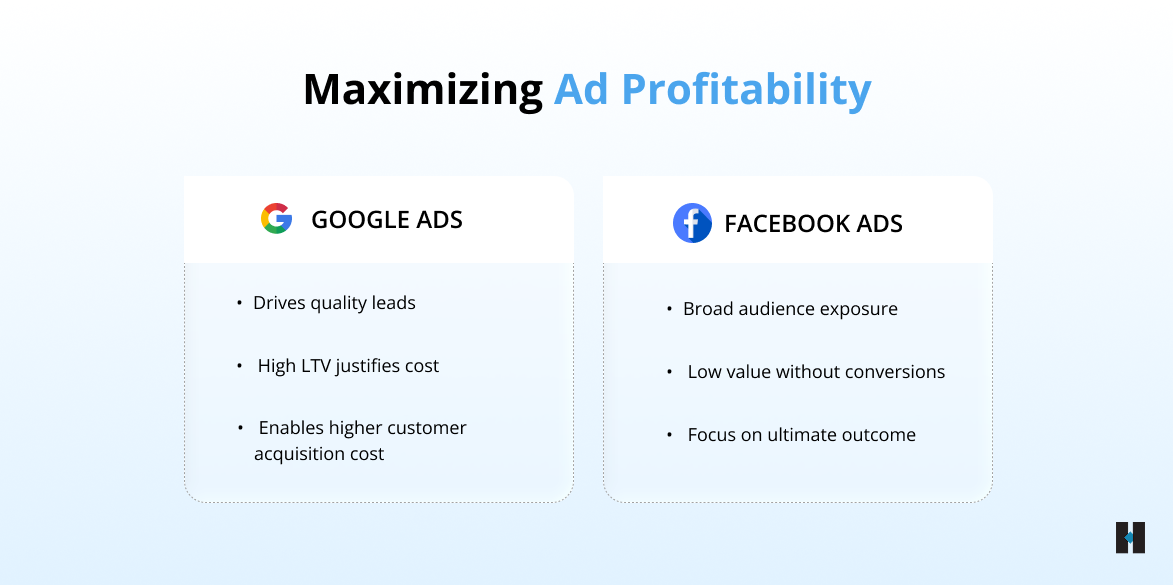
Google Ads often has higher intent but higher competition. Facebook Ads often have cheaper reach but require stronger creativity and more nurturing.
That means ROI depends on more than CPC or CPM.
A cheap click from Meta is not valuable if it does not convert. An expensive Google click can still be profitable if it brings in a high-LTV customer. For DTC, the better metric is not simply cost per click. It is the contribution margin after ad spend.
Shopify notes that DTC brands lack the built-in audiences that major retailers or marketplaces have, so they need proactive marketing channels such as paid ads, influencer marketing, SMS, communities, and email to drive demand.
That is why DTC ROI should not be judged only on the first order. A brand with strong retention may afford a higher CAC because customers buy again. A brand with low repeat purchase and thin margins needs stricter acquisition targets.
For example:
If your AOV is $60 and gross margin is 60%, you have $36 gross margin before shipping, discounts, transaction fees, and operating costs. A $40 CAC may look acceptable in ad reports, but it may be unprofitable on the first order.
If your AOV is $120, gross margin is 70%, and customers reorder every two months, you may be able to pay more for acquisition because the lifetime value supports it.
This is where many DTC brands make the wrong decision. They ask, “Which platform has better ROAS?” when they should ask, “Which platform brings better customers?”
Google may produce higher immediate ROAS. Meta may produce more new customers and future branded searches. The better ROI depends on your business model.
How DTC Brands Should Use Google and Facebook Together?
DTC brands should use Google Ads and Facebook Ads as one connected system, not as separate channels. Facebook is better for creating demand, while Google is better for capturing demand.
Facebook and Instagram help introduce products to people who may not be actively searching yet. This makes them useful for awareness, product education, lifestyle creatives, UGC videos, reviews, and retargeting. A customer may first discover a skincare product, fashion item, or wellness product through a Facebook ad before they ever search for it.
Google Ads should then capture users when they show buying intent. When someone searches for terms like “best LED face mask,” “buy protein powder online,” or “IPL hair removal device,” they are already closer to purchase. Search Ads, Shopping Ads, and Performance Max can help bring these users to the product page.
The two platforms should also share insights. Winning Facebook ad angles can improve Google ad copy and landing pages. Google search terms can inspire Facebook creatives.
Together, Facebook builds interest, and Google captures intent, giving DTC brands a stronger full-funnel strategy and better overall ROI. tecHindustan helps brands align both channels through better campaign coordination, clearer attribution, and more efficient customer acquisition.
Ready to build a connected Google and Facebook advertising strategy? Contact our team to discuss your growth goals.
Final Thoughts
For DTC brands, the Google Ads vs. Facebook Ads debate should not be treated as a winner-take-all decision.
Google Ads and Facebook Ads solve different problems. Google helps you reach shoppers who are already looking. Facebook helps you reach people before they know what to search for. Google is intent-led. Facebook is creative-led. Google often closes the sale. Facebook often starts the journey.
The better ROI comes from knowing the role of each platform.
A DTC brand with strong search demand, optimized product pages, and competitive pricing may see faster returns from Google Ads. A brand with a visually compelling product, a strong story, and a need for customer education may scale faster through Facebook Ads. A mature DTC brand should usually use both, with clear separation between prospecting, retargeting, branded search, Shopping, and retention.
The goal is not to pick the cheaper platform.
The goal is to build a paid media system where every rupee or dollar spent moves the customer closer to purchase, repeat purchase, and long-term brand loyalty.
FAQs
