

The success of an enterprise application depends not only on its features but also on the technology used to build it. Choosing the right frontend framework can directly impact application performance, scalability, development speed, maintenance, and long-term business growth. This is why the discussion around React vs Angular for enterprise applications has become increasingly important for businesses planning digital transformation initiatives.
The challenge is that both React and Angular are powerful solutions for enterprise web application development, yet they are designed differently and offer unique advantages. As a result, many businesses struggle to determine which option best aligns with their goals, technical requirements, and future growth plans.
In this guide, you will learn the key differences between React and Angular, including their architecture, performance, scalability, security, and development approach. Before diving into the detailed comparison, it is important to first understand what React and Angular are and how they support enterprise application development.
What Are React and Angular and How Do They Work
Before comparing React vs Angular for enterprise applications, it is important to understand what each technology offers and why businesses choose them for enterprise web application development.
What Is React
React is a popular JavaScript library developed by Meta for building interactive and dynamic user interfaces. It uses a component-based approach, allowing developers to create reusable elements that make applications easier to manage and scale. For example, components such as navigation menus, dashboards, or user profiles can be reused across different sections of an application. React enterprise development is widely preferred for customer-facing platforms, SaaS products, and applications that require fast and responsive user experiences.
What Is Angular
Angular is a full frontend framework developed by Google. Unlike React, it comes with built-in features for routing, form handling, dependency injection, and state management. This structured approach makes Angular enterprise development a strong choice for large-scale business applications such as ERP systems, financial platforms, and internal enterprise portals where consistency, maintainability, and long-term scalability are important.
The Importance of Framework Selection in Enterprise Development
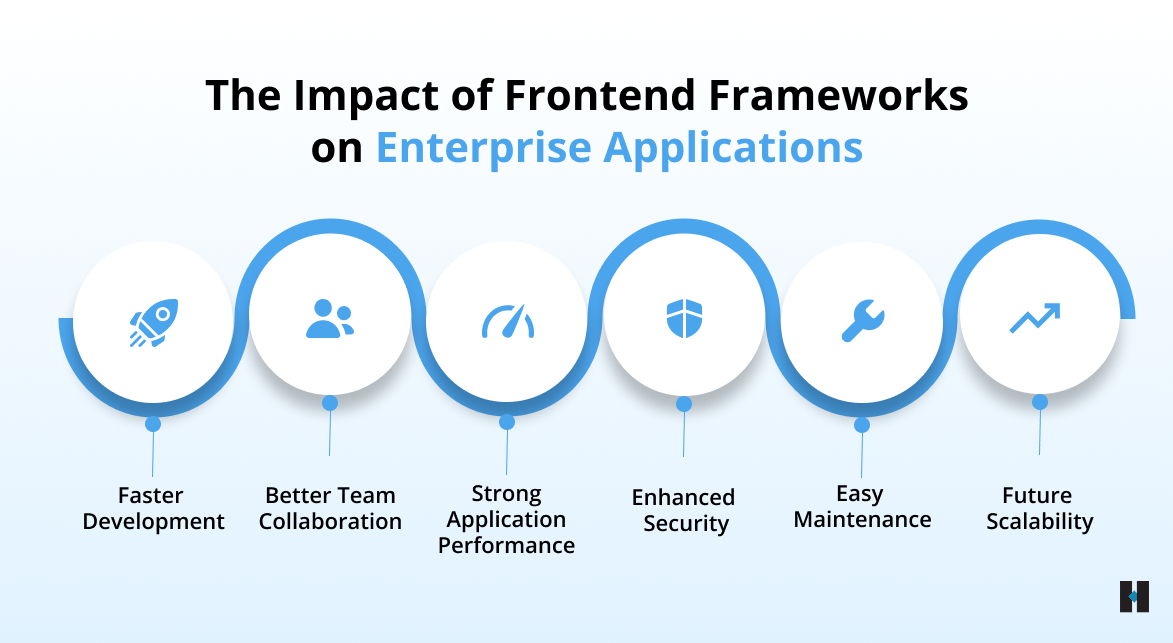
Choosing the right frontend framework is one of the most important decisions in enterprise application development. A framework does much more than support the user interface. It directly affects how easily your application can scale, adapt to future requirements, and perform over time.
Enterprise applications are often large and complex, with multiple modules, integrations, dashboards, user roles, and business workflows. If the framework is not suited to your needs, it can lead to higher maintenance costs, slower development, and scalability challenges in the future.
Some of the key areas affected by framework selection include:
- Development speed and productivity
- Team collaboration and code consistency
- Application performance and stability
- Security and risk management
- Long-term maintenance and scalability
This is why businesses comparing React vs Angular for enterprise applications should look beyond features alone and choose a solution that aligns with both their technical requirements and long-term business goals.
Comparing React and Angular for Enterprise Applications
When comparing React vs Angular for enterprise applications, it is easy to get overwhelmed by technical details. Both technologies are widely used in enterprise web application development and have proven their ability to support large-scale, business-critical systems. However, they differ in terms of flexibility, architecture, development approach, and built-in capabilities.
The comparison table below provides a quick overview of the most important factors businesses should evaluate before choosing a frontend framework. It can help you understand where React and Angular excel and which option may be better suited to your specific project requirements.
| Feature | React | Angular |
| Type | JavaScript Library | Full Frontend Framework |
| Developed By | Meta | |
| Learning Curve | Easier | Steeper |
| Flexibility | Highly Flexible | More Structured |
| Performance | Excellent for Dynamic UIs | Strong for Large Enterprise Systems |
| State Management | Uses External Libraries | Built-In Solutions Available |
| Development Speed | Faster for Custom Projects | Faster for Structured Projects |
| Scalability | Highly Scalable | Highly Scalable |
| Security Features | Requires Additional Implementation | Strong Built-In Security Features |
| Best For | Interactive Applications, SaaS, Ecommerce | ERP Systems, Enterprise Platforms, Internal Applications |
| Community Support | Very Large | Large and Enterprise-Focused |
| Enterprise Adoption | High | High |
While this table offers a quick snapshot, choosing the right framework requires a deeper understanding of how React and Angular compare in areas such as architecture, performance, scalability, security, and long-term maintenance. The following sections will break down these factors in more detail to help you make a well-informed decision.
Choosing Between React and Angular for Enterprise Development
While the comparison table provides a quick overview, selecting the right frontend technology requires a deeper understanding of how React and Angular perform in real-world enterprise environments. Both technologies are widely used for enterprise application development, but they take different approaches to architecture, scalability, performance, and development workflows. Understanding these differences can help you choose a framework that aligns with your business goals and technical requirements.
- Architecture and Development Approach
One of the biggest differences in the React vs Angular comparison is how they are structured. React is a JavaScript library that focuses primarily on building user interfaces. It follows a component-based architecture, allowing developers to create reusable components that can be used across different parts of an application. For example, a dashboard widget, navigation menu, or user profile card can be built once and reused whenever needed. This approach gives developers a high level of flexibility when designing applications. Angular, on the other hand, is a complete frontend framework. It comes with a predefined structure and includes many built-in features such as routing, dependency injection, form handling, and state management. This makes Angular more structured and consistent, especially when multiple development teams are working on the same enterprise application. Another important difference is state management. React often relies on external tools such as Redux or Context API, while Angular provides built-in solutions that simplify the management of complex business workflows.
- Performance and User Experience
Performance is a major factor when comparing React vs Angular for enterprise applications.
React uses a Virtual DOM, which updates only the parts of the interface that change. This helps improve rendering speed and creates smoother user experiences, especially in applications with frequent updates and user interactions.
Because of this, React is often used for applications such as:
- Real-time dashboards
- SaaS platforms
- Customer portals
- Interactive business applications
Angular also delivers strong performance, particularly for large and complex enterprise systems. Its structured architecture helps maintain stability as applications grow. It is commonly used for data-heavy applications where consistency and reliability are important.
In most enterprise scenarios, both frameworks can deliver excellent performance when implemented correctly. The best choice often depends on the type of application you are building.
- Scalability and Long-Term Growth
Enterprise applications are expected to grow over time, making scalability a critical consideration. React provides flexibility that allows businesses to scale applications gradually. Teams can add libraries, integrations, and new features as business requirements evolve. This makes React a strong option for organizations that expect rapid growth or changing product requirements. Angular supports scalability through its structured architecture. Large organizations often prefer Angular because it helps maintain consistency across multiple development teams. When projects become more complex, having standardized development practices can simplify maintenance and collaboration. For businesses focused on long-term enterprise growth, both React and Angular offer strong scalability. The decision often comes down to whether you value flexibility or a more standardized development approach.
- Development Speed and Productivity
Development efficiency can directly affect project timelines and costs. React is known for enabling faster UI development because of its reusable components and flexible ecosystem. Developers can choose the tools and libraries that best fit their needs, allowing teams to move quickly when building custom applications. Angular includes many built-in features, reducing the need for additional third-party tools. This can improve consistency and reduce setup time for enterprise projects that require a well-defined structure from the beginning. If speed and customization are priorities, React may offer an advantage. If consistency and predefined workflows are more important, Angular can simplify the development process.
- Security and Enterprise Stability
Security is essential for enterprise applications that manage sensitive business and customer data. Angular includes several built-in security features that help developers follow secure development practices. These built-in capabilities make it a popular choice for organizations with strict security requirements. React also supports secure application development, but developers often need to implement additional security measures and follow best practices during development. Both frameworks are mature, reliable, and widely adopted by enterprises worldwide. React benefits from the support of Meta, while Angular is backed by Google. This strong ecosystem support ensures ongoing updates, stability, and long-term reliability. Ultimately, both React and Angular are capable of supporting modern enterprise applications. The best choice depends on your project's complexity, development goals, scalability requirements, and long-term business strategy.
Common Challenges Businesses Face While Choosing Between React and Angular
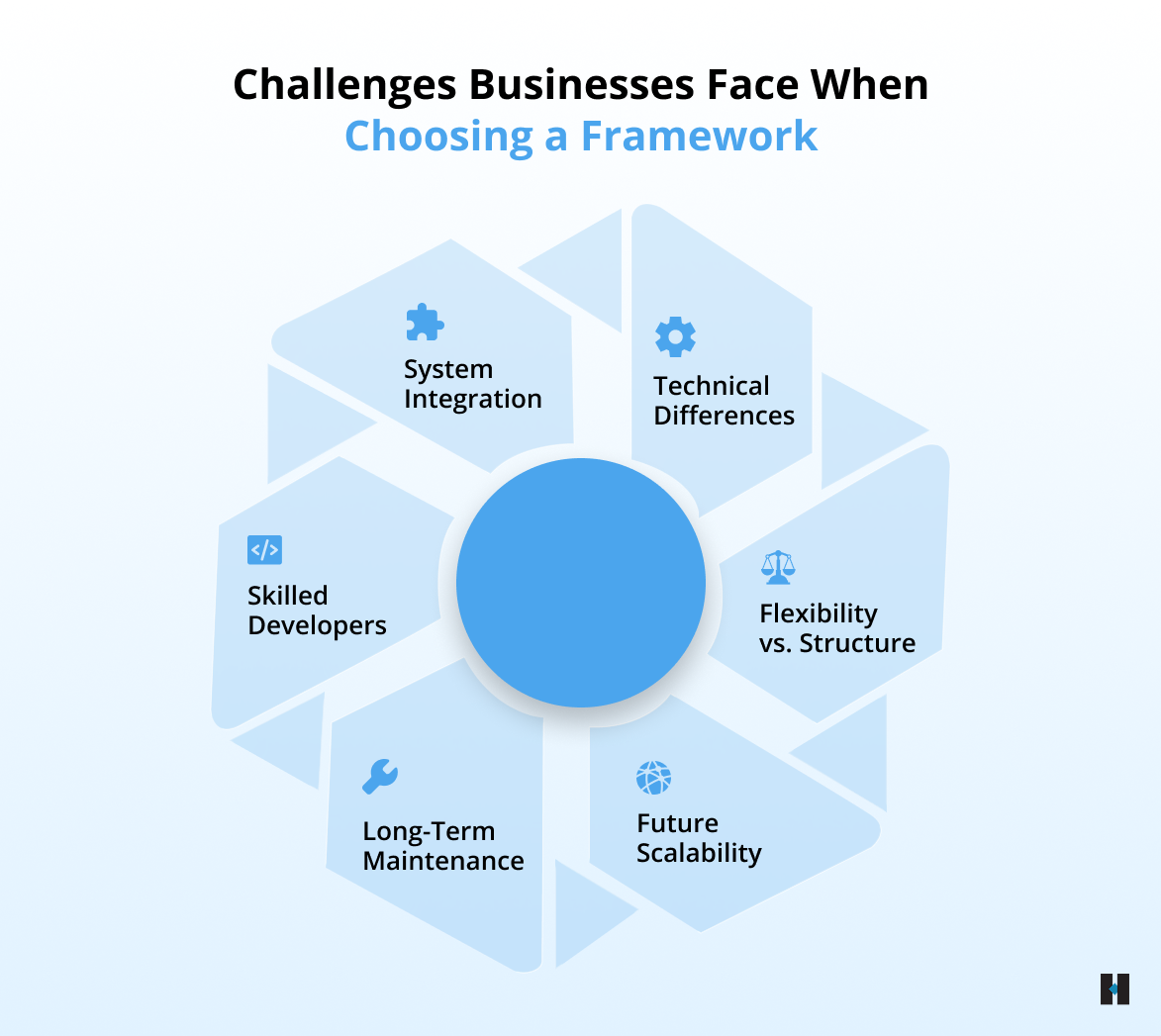
Choosing between React and Angular for enterprise applications is not always straightforward. Both technologies are powerful, widely adopted, and capable of supporting large-scale enterprise solutions. However, businesses often face several challenges when deciding which framework best fits their needs.
- Understanding Technical Differences: React and Angular follow different development approaches, making it difficult for non-technical stakeholders to understand which option aligns better with business goals.
- Balancing Flexibility and Structure: Some businesses need the flexibility React offers, while others benefit from Angular’s structured framework. Finding the right balance can be challenging.
- Predicting Future Scalability: It is not always easy to determine how application requirements will evolve and which framework will better support future growth.
- Managing Long-Term Maintenance: Businesses must consider how easily the application can be maintained, updated, and expanded over time.
- Finding Skilled Developers: Access to experienced React or Angular developers can influence project timelines and long-term support.
- Integrating Existing Systems: Enterprise applications often need to connect with legacy software, third-party tools, and internal platforms, making framework selection more important.
Many businesses focus on popularity rather than actual project requirements. If you are facing these challenges, you can connect with the experts at tecHindustan. We help businesses evaluate requirements, choose the right technology stack, and build scalable enterprise applications that support long-term growth and performance.
Which Businesses Benefit Most From React or Angular?
The choice between React and Angular for enterprise applications depends largely on your business goals, application requirements, and long-term development strategy. While both technologies are suitable for enterprise web application development, they are often used for different types of projects.
When React Is the Better Choice
React is well-suited for businesses building highly interactive and user-focused applications. It works particularly well for SaaS platforms, ecommerce websites, customer portals, and real-time dashboards where flexibility and fast user experiences are important. For example, an ecommerce platform that frequently introduces new features and personalized user experiences may benefit from React’s adaptable architecture.
When Angular Is the Better Choice
Angular is often preferred for complex enterprise systems that require structure and consistency. It is commonly used for ERP systems, financial platforms, internal business portals, and data-heavy applications. For example, a large organization managing multiple teams and workflows may benefit from Angular’s standardized framework and long-term maintainability.
Ultimately, the best choice depends on your application’s complexity, scalability requirements, and future business goals.
How to Choose the Right Framework for Your Enterprise Application
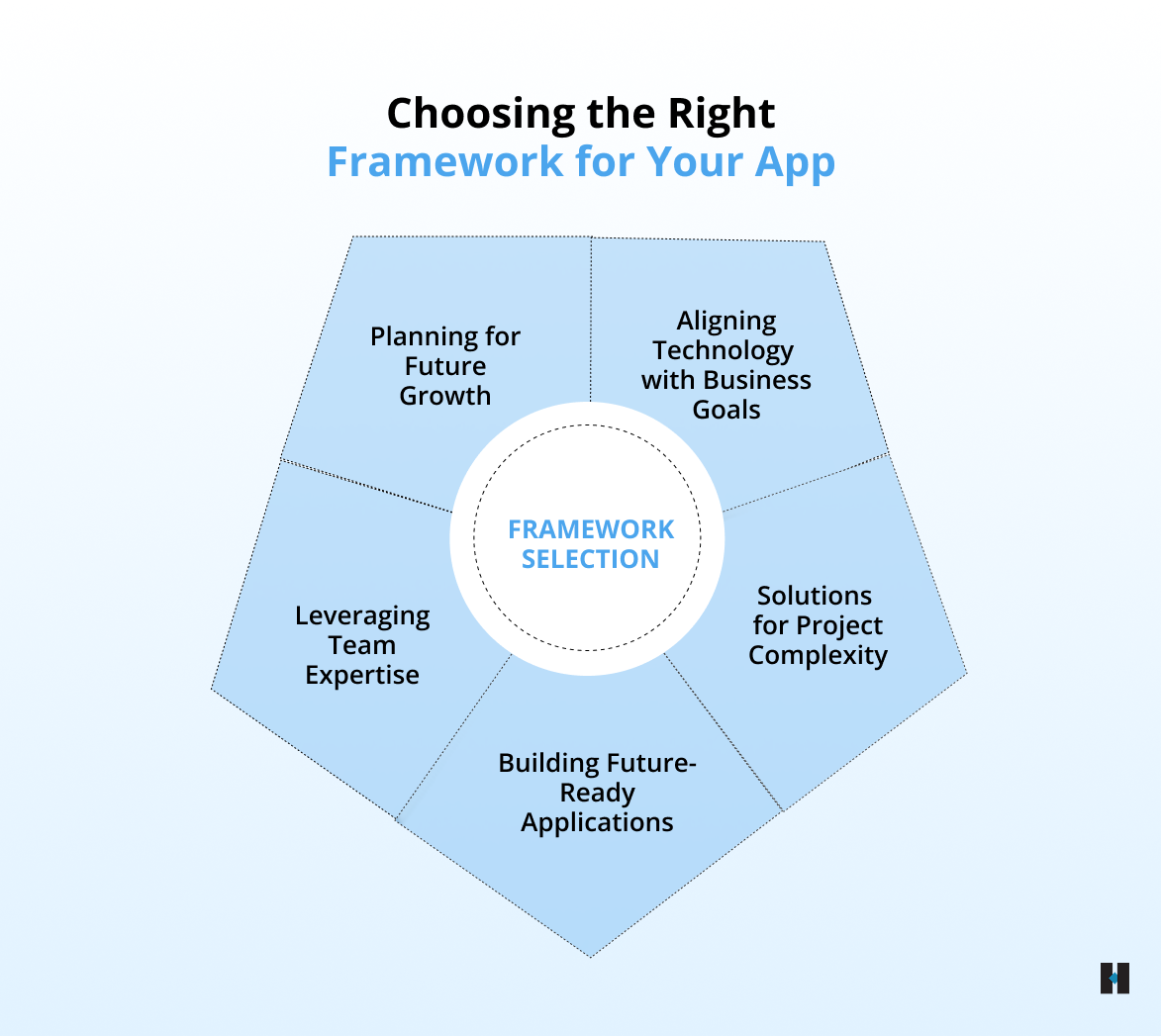
Choosing between React and Angular for enterprise applications should be based on your business goals, project requirements, and long-term plans rather than popularity alone. The right framework can help improve development efficiency, scalability, and future maintenance.
Before making a decision, consider the following factors:
- Business Goals: Determine whether your priority is flexibility, faster development, scalability, or a structured architecture.
- Project Complexity: Large enterprise systems often have different requirements than smaller or less complex applications.
- Team Expertise: The experience of your development team can influence productivity, development speed, and long-term support.
- Long-Term Maintenance: Enterprise applications typically evolve over time, making maintainability an important consideration.
- Scalability Requirements: Choose a framework that can support future growth, integrations, and changing business needs.
Evaluating these areas carefully can help you make a more informed and future-ready technology decision.
How tecHindustan Creates Future-Ready Enterprise Applications
Building a successful enterprise application requires more than choosing between React and Angular. It requires the right strategy, architecture, development approach, and long-term support to ensure sustainable growth and performance.
- Strategic Planning and Technology Selection
We begin by understanding your business goals, project requirements, scalability needs, and existing technology ecosystem. This helps us recommend the most suitable frontend framework and development roadmap for your enterprise application.
- Enterprise Application Development
Our team develops scalable enterprise solutions using React and Angular, focusing on performance, security, maintainability, and seamless user experiences.
- Optimization and Modernization
We help businesses modernize legacy applications, improve UI and UX, optimize frontend performance, and build scalable architectures that support future growth.
- Long-Term Support and Scalability
Beyond development, we provide ongoing maintenance, performance monitoring, and continuous improvements to help applications adapt as business needs evolve. At tecHindustan, we build future-ready enterprise applications that support scalability, efficiency, and long-term business success.
Conclusion
Both React and Angular are powerful enterprise frontend frameworks capable of supporting large-scale applications. The right choice depends on your business goals, scalability requirements, development approach, and long-term maintenance strategy.
React offers flexibility, faster UI development, and highly dynamic user experiences, while Angular provides structured architecture, built-in enterprise features, and stronger standardization for large development teams.
If you are planning to build or modernize an enterprise application, choosing the right frontend technology is an important long-term decision. You can connect with the experienced professionals at tecHindustan for expert guidance, scalable enterprise application development, frontend architecture planning, and long-term technology solutions designed to support performance, scalability, and business growth.
FAQs
