

Quick Verdict for Busy Readers
Short on time? Here is the TL;DR:
Choose Klaviyo if:
- You are an e-commerce-first brand on Shopify, WooCommerce, or BigCommerce
- You want deep segmentation, including predictive CLV, churn risk, and product affinity
- Automated lifecycle flows like cart recovery, replenishment, and post-purchase are critical
- You are ready to maximize email and SMS revenue share
Choose Mailchimp if:
- You are a content-driven or small service-based business
- You need simple newsletters and basic automations
- You want a budget-friendly option with easy setup
- You are focusing more on brand building than on ecommerce revenue optimization
Pro insight:
At tecHindustan, as a Klaviyo Gold Partner, we have seen ecommerce brands double or even triple their email-driven revenue in less than 6 months with Klaviyo.
Mailchimp works well for lighter use cases, but scaling ecommerce typically demands Klaviyo.
Email marketing is more than just another channel. It is one of the most reliable ways to grow a business, consistently ranking among the highest-return investments in ecommerce. Studies show that for every dollar spent, businesses can earn between $10 and $36 back. That kind of return explains why nearly 81% of small and medium-sized businesses use email as their main tool to acquire customers, and 80% rely on it to keep those customers coming back.
But here is where many businesses struggle. Not every platform is built to deliver that kind of impact. The right tool helps you turn customer data into meaningful connections and steady revenue. The wrong tool leaves your emails unopened, your campaigns unnoticed, and your sales pipeline running dry.
That is why choosing the right platform matters. In this guide, we will walk with you through Klaviyo and Mailchimp, two of the most popular tools in the market today. We will show you what makes them different, which types of businesses they serve best, and how other brands are already using them to grow.
By the end, you will not just know the features on paper. You will have the clarity to choose the platform that feels right for your business, the one that supports your goals, your growth, and your next stage of success.
Klaviyo: E-commerce-Focused Marketing Platform
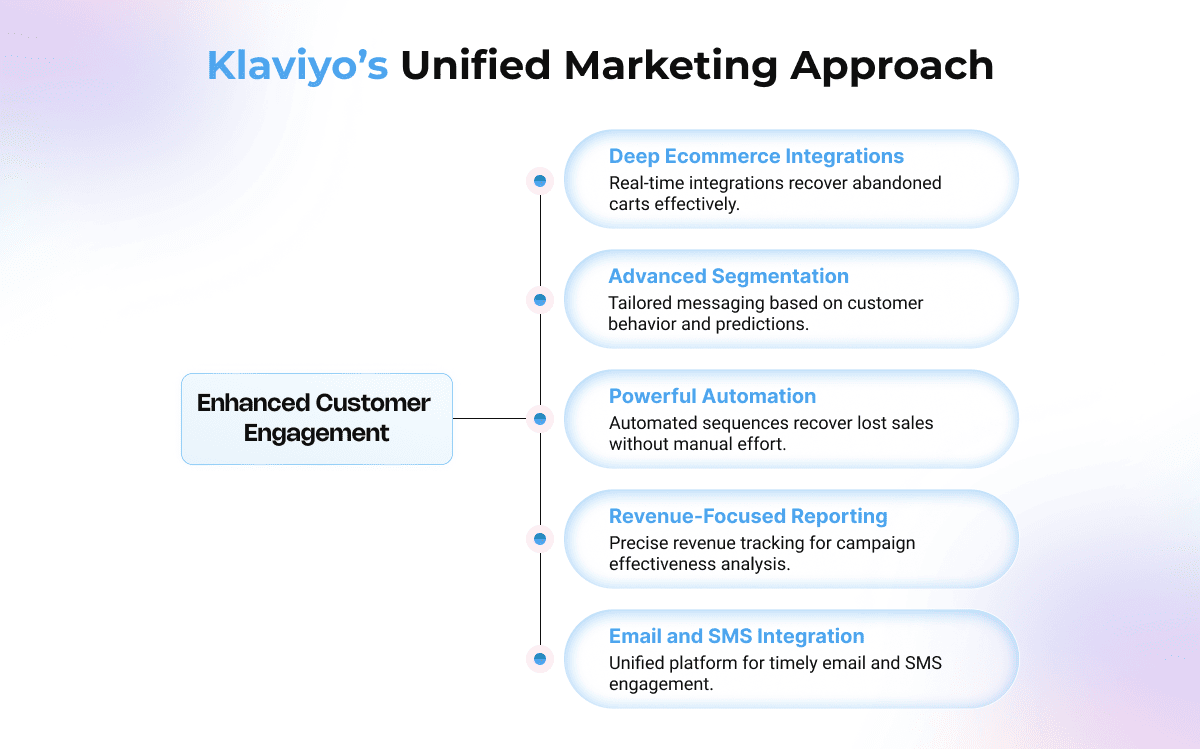
Klaviyo is an email and SMS marketing platform designed for ecommerce businesses. It helps online stores use customer data to create personalized campaigns that drive sales and build stronger relationships.
Think of it as a personal shopping assistant for your brand, always ready with the right recommendation at the right moment.
Key Features of Klaviyo:
- Deep ecommerce integrations: Imagine this: a customer adds sneakers to their cart on your Shopify store, but leaves without checking out. With Klaviyo’s real-time integrations across Shopify, WooCommerce, and BigCommerce, you can follow up instantly with a gentle reminder, helping you win back that sale before it slips away.
- Advanced segmentation: Instead of blasting the same message to everyone, Klaviyo helps you talk to customers based on their actual behavior. For example, you could create a group of shoppers who spent more than $200 in the last 90 days but haven’t returned this month. Klaviyo can even predict who is likely to come back and who might churn, so your messages always reach the right people at the right time.
- Powerful automation (flows): Think of automation as your silent sales assistant. When someone abandons their cart, Klaviyo sets up a sequence for you: a reminder first, then maybe a request for a review, and finally a discount if they still don’t complete the purchase. Many brands recover up to 30% of lost sales this way, without lifting a finger each time.
- Revenue-focused reporting: Open rates and clicks are nice, but what you really want to know is: did this campaign make money? Klaviyo shows you exactly how much revenue comes from each campaign. It feels like checking your dashboard and also seeing how efficiently you are running the engine.
- Email and SMS together: Timing matters. With Klaviyo, you don’t have to juggle two different platforms. You can send a flash sale email in the morning, then follow up with a quick SMS reminder in the evening, keeping your customers engaged on the channels they use most.
In short, Klaviyo is like a high-performance sports car built for ecommerce highways. Fast, data-driven, and ROI-focused.
Mailchimp: General-Purpose Email Platform
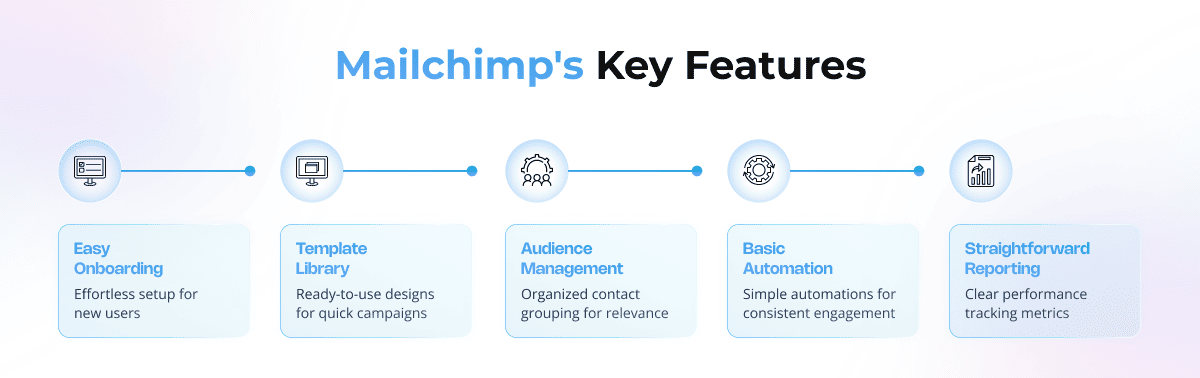
Mailchimp is a general-purpose email marketing platform designed for businesses of all sizes. It provides an easy way to create, send, and track email campaigns without needing advanced technical skills.
Think of it as a Swiss Army knife. It may not be specialized, but it offers a little bit of everything you need to start email marketing.
Key Features of Mailchimp:
- Easy onboarding: Starting with Mailchimp feels effortless. The interface is simple enough for first-timers, like stepping into a furnished apartment where everything is already set up. All you need to do is bring your content and hit send.
- Template library: Designing campaigns does not require design skills. With hundreds of ready-to-use templates, you can set up emails in minutes. A bakery, for example, could drop in cupcake photos, tweak the text, and launch a product update instantly.
- Audience management with tags: Mailchimp helps you keep your contacts organized. You can group people into lists like “loyal customers” or “event attendees.” While it does not predict future actions, it ensures your messages feel relevant rather than random.
- Basic automation: Mailchimp makes it easy to stay consistent. You can set up simple automations like welcome emails for new subscribers, birthday discounts, or reminders for inactive customers. It is especially useful for small businesses that want a connection without complexity.
- Straightforward reporting: Understanding your performance is simple. Mailchimp tracks open rates, clicks, and unsubscribes, much like a fitness tracker. It shows you whether you are moving in the right direction, even if it doesn’t forecast the road ahead.
In short, Mailchimp is like a reliable hatchback. Affordable, easy to drive, and perfect for everyday use, though not built for high-performance ecommerce needs.
Pricing and Total Cost of Ownership
When businesses compare Klaviyo and Mailchimp, pricing is often the first thing they look at. But here’s the reality: the “cheaper” option on paper doesn’t always translate to the “better value” in practice. To make the right decision, it’s important to see not just what you’ll pay each month, but what you’re likely to get in return.
Klaviyo
Klaviyo does not aim to be the cheapest option. Instead, it positions itself as the platform that helps you earn more. Rather than cutting corners or limiting features, Klaviyo gives you everything up front so you can focus on turning customer data into real revenue.
Here’s what makes its pricing different:
- No long-term free plan beyond a short trial.
- Pricing scales with the number of active profiles, covering both email and SMS contacts.
- All advanced features like automation, segmentation, and reporting are included by default. There are no hidden costs for the essentials.
- SMS charges vary by region, but the integration with email keeps it simple to manage.
For example, an ecommerce store with 20,000 subscribers might pay around $500 per month. At first glance, this feels steep. But once flows like cart recovery, upsell campaigns, and win-back sequences are in motion, many businesses see 10–20 times that amount return to them every month.
Klaviyo is more like investing in a long-term asset. It may feel costly at the beginning, but over time it generates far greater returns than a quick, inexpensive fix.
Mailchimp
Mailchimp, on the other hand, is built for beginners and businesses testing the waters. It feels approachable and budget-friendly, making it a popular entry point into email marketing.
Here’s how the pricing works:
- A free plan for up to 500 contacts, ideal for small businesses or those just starting out.
- Paid plans begin at $13 per month, which feels affordable and easy to justify.
- As your list grows, pricing rises quickly, and additional costs appear when you add advanced automation, transactional emails, or extras.
For instance, a consultancy with 2,000 subscribers might pay around $39 per month. This setup is perfect for newsletters or occasional campaigns, but it is not designed for the demands of large-scale ecommerce.
Mailchimp works more like a starter apartment. The rent is affordable, and it comes furnished, which is great at the beginning. But as your needs expand, you may find yourself outgrowing the space.
The Key Takeaway
At first glance, Mailchimp is the cheaper choice, and for businesses with light email needs, it absolutely delivers on value. But for ecommerce brands where every customer interaction counts, Klaviyo quickly justifies its price by driving measurable revenue growth.
So the real question is not “Which tool has the lower subscription cost?” but “Which tool will help your business earn more in the long run?”
How Each Platform Connects With Your Store and Tools
When choosing an email platform, the first big question is: How well does it connect with the tools I already use?
Klaviyo was built with ecommerce at its core. It has deep, native integrations with platforms like Shopify, WooCommerce, and BigCommerce. That means it does not just sync basic information like customer names and emails, but also pulls in product data, order history, and customer behavior in real time.
Imagine being able to see that someone bought running shoes last month and then building a campaign around the idea that they probably need socks or gym accessories next.
Mailchimp, on the other hand, integrates with more than 300 apps. Sounds impressive, right? But here’s the catch: while the range is wide, the depth is shallow when it comes to ecommerce. It shines more in general marketing apps like Canva, Eventbrite, or SurveyMonkey. That makes it handy if you run a community newsletter, host events, or need simple marketing add-ons.
Action Example: With Klaviyo, you can create a segment like “customers who bought running shoes in the last 90 days but have not purchased socks.”
Mailchimp can only tag them as “shoe buyers,” but it stops short of predicting what they are likely to buy next. That predictive ability is where Klaviyo gives ecommerce stores a competitive edge.
How Deep Can You Personalize With Each Tool?
Here is where the difference really comes alive. Ask yourself: Do I just want to group my audience, or do I want to predict their behavior?
Klaviyo goes beyond simple tags. It uses predictive analytics, purchase intent modeling, and churn risk scoring. That means it does not just tell you what your customers did in the past; it also helps you forecast what they might do next. Think about how powerful that is for targeting campaigns.
Mailchimp is more traditional. It allows basic segmentation with tags, groups, and demographic filters like age or location. This works fine if your goal is to separate broad audiences, say “newsletter readers in New York” versus “subscribers in London.” But it stops short of telling you who is slipping away or who is most likely to buy again soon.
Practical Recipes with Klaviyo:
- Target VIPs with an above-average order value → offer them early access to new launches.
- Find dormant customers who have not ordered in 90 days → send them a win-back discount.
- Spot high-engagement non-buyers who keep clicking but never check out → show them personalized product recommendations.
With Klaviyo, you get to act like a mind-reader for your customers. Mailchimp keeps things simple and serviceable, but it lacks those predictive layers that drive real ecommerce growth.
How Each Platform Handles Customer Lifecycle Marketing
This is the part most brands are excited about: what can I automate so I don’t have to chase every customer manually?
Klaviyo shines here. It offers a full library of lifecycle flows like welcome series, abandoned cart reminders, browse abandonment nudges, post-purchase upsells, and replenishment reminders. These flows are customizable, letting you tweak timing, add conditions, and use dynamic data.
Mailchimp supports automation, too, but it is more limited. You can set up welcome series, basic nurture journeys, and re-engagement campaigns. They are effective if you are running a content newsletter or light campaigns, but they don’t go deep into ecommerce behaviors.
Example Flow (Klaviyo abandoned cart):
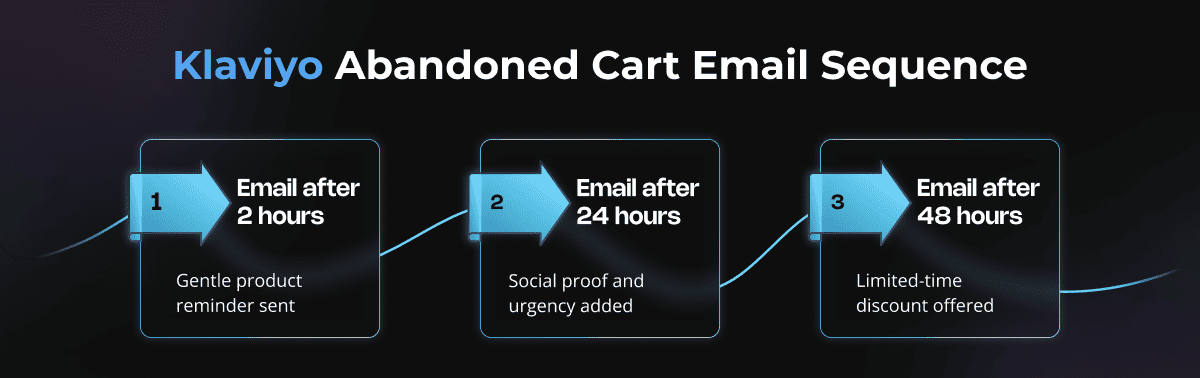
- Email after 2 hours → gentle product reminder.
- Email after 24 hours → add social proof with urgency (like “people love this item, don’t miss out”).
- Email after 48 hours → send a limited-time discount.
This type of journey recovers 20–30 percent of lost carts. Mailchimp supports cart recovery, too, but the customization and depth just are not the same.
Which Platform Makes Campaign Building Easier?
If you have ever sat down to build a campaign, you know design is half the battle.
Klaviyo lets you create dynamic templates that can pull live product data, such as “recommend products from the last viewed category.” It means every email feels personal, even at scale. For ecommerce brands, that is priceless.
Mailchimp, however, has a larger pre-built template library. Its drag-and-drop editor is easier for beginners who do not want to fuss over customization. If you are a small business with limited design needs, Mailchimp can get you up and running quickly.
So here is the takeaway: If your store thrives on personalized shopping experiences, Klaviyo wins. If you need something simple and design-light, Mailchimp keeps it easy.
Deliverability, Compliance, and Sender Reputation
Both tools cover the basics like SPF, DKIM, and DMARC authentication, GDPR and CCPA compliance tools, and list cleaning features. But there is still a difference in depth.
Klaviyo offers advanced list hygiene and predictive engagement scoring. It helps you identify subscribers who are at risk of disengaging before they actually do.
Mailchimp offers strong deliverability, especially for small lists, but lacks the predictive analysis that keeps large ecommerce lists healthy.
Pro Tip: Regardless of platform, run a monthly list cleaning routine. Sunset profiles that have not opened in 180 days to protect your sender reputation and keep your campaigns out of spam folders.
How Reporting Differs Between Klaviyo and Mailchimp
Here is where most marketers get frustrated: Did this email really drive sales, or did people just browse?
Klaviyo answers that with ecommerce-focused reporting. It can show you revenue per recipient, placed order rate, and even product-level performance. Imagine a report telling you, “customers who bought Product A are 40 percent more likely to buy Product B.” That level of insight can directly shape your next campaign.
Mailchimp keeps reporting simpler. You get campaign metrics like opens, clicks, and unsubscribes. Useful, yes, but not deep enough to tell you which products are driving revenue or which segments respond best.
Klaviyo’s Native SMS vs Mailchimp’s Third-Party Approach
Email is powerful, but what happens when you add SMS to the mix?
Klaviyo has native SMS integration in the US and EU. You can weave SMS directly into your email flows, complete with predictive send times. Imagine running a flash sale: the email goes out in the morning, then a perfectly timed SMS reminder lands during peak hours. Conversions spike.
Mailchimp does not have built-in SMS. It relies on third-party integrations, which adds complexity and sometimes extra cost.
So if you want true omnichannel campaigns that sync smoothly, Klaviyo gives you the edge.
Who Should Pick What?
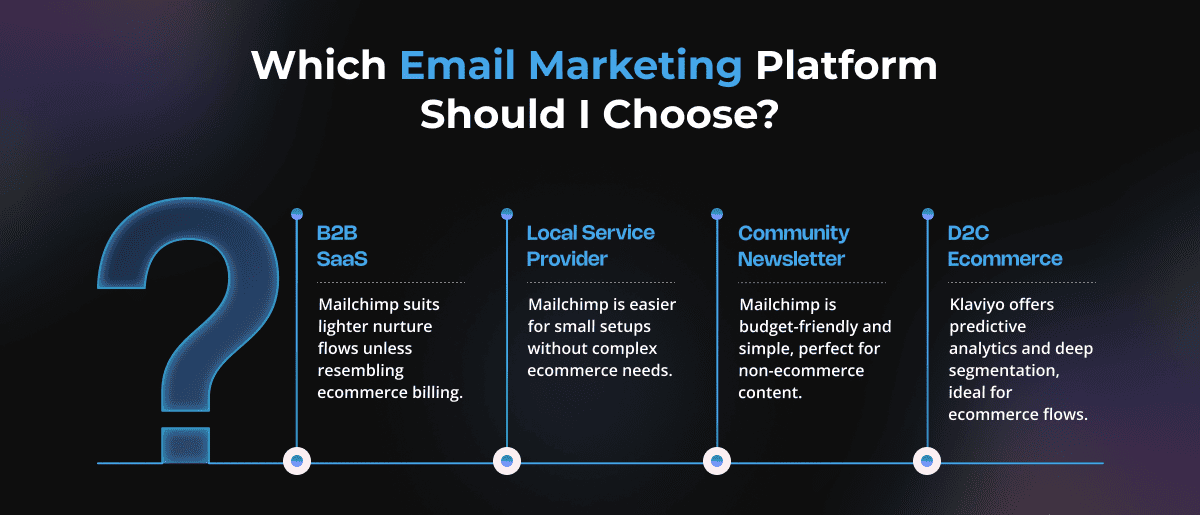
So, which platform is right for you? Let’s make it simple:
- D2C Ecommerce Store: Klaviyo. The predictive analytics, deep segmentation, and ecommerce flows make it a natural fit.
- Content or Community Newsletter: Mailchimp. Budget-friendly, simple to use, and great for non-ecommerce content.
- B2B SaaS: Mailchimp. Works well for lighter nurture flows unless your SaaS model resembles ecommerce billing.
- Local Service Provider: Either works, but Mailchimp is easier for small setups without complex ecommerce needs.
Quick Comparison Chart: Klaviyo vs Mailchimp
| Criteria | Best Fit |
|---|---|
| Ecommerce focus | Klaviyo |
| Simple newsletters | Mailchimp |
| Deep segmentation needs | Klaviyo |
| Budget-first decision | Mailchimp |
| SMS as a channel | Klaviyo |
| Predictive analytics | Klaviyo |
| Low-tech team setup | Mailchimp |
How Automation Boosted Email Revenue for an Apparel Brand
An apparel brand with 18,000 subscribers was using Mailchimp for its email marketing. While Mailchimp helped them send basic newsletters, the brand felt it was not unlocking the full potential of their growing customer base. Their emails were often generic, and they struggled to deliver the right message to the right customer at the right time.
After switching to Klaviyo, the brand decided to put more focus on automation and customer journeys rather than one-off campaigns. They built five automated flows:
- Cart recovery emails to remind shoppers about items they left behind.
- Post-purchase emails to thank customers and keep them engaged.
- Win-back emails to re-engage customers who had not purchased in a while.
- Replenishment reminders for products that people usually reorder, like basics or seasonal wear.
- Exclusive VIP offers for their most loyal customers.
Instead of sending the same email to everyone, these flows allowed the brand to tailor communication to each stage of the customer journey. For example, a shopper who abandoned a cart received a friendly reminder with a discount, while a repeat buyer was surprised with early access to a new collection.
The results were impressive. Within just 90 days, the share of revenue coming from email jumped from 12 percent to 28 percent. In other words, email almost tripled its contribution to sales. Customers felt like the brand “got them” and responded by buying more often.
For the brand, the switch to Klaviyo was more than just moving platforms. It was about shifting from mass communication to personalized relationships. By letting automation handle the heavy lifting, their marketing team freed up time to focus on creative ideas, knowing that every subscriber was being nurtured in a smart and timely way.
Common Mistakes to Avoid
- Buying email lists – Often results in low engagement, spam complaints, and a damaged sender reputation since the audience never opted in.
- Over-emailing – Bombarding subscribers can annoy them, lowering open rates and pushing them to unsubscribe.
- Ignoring mobile design – With most emails opened on phones, poor mobile design makes your message hard to read or interact with.
- No clear CTA – Without a clear call-to-action, readers won’t know the next step to take, wasting your campaign effort.
- Skipping deliverability warm-up – Sending bulk emails right away raises spam flags; gradual warm-up builds trust with inbox providers.
Why Partner With tecHindustan?
At tecHindustan, we are a Klaviyo Gold Partner, a recognition that only a few agencies worldwide achieve. This means:
- We know the platform inside out
- We can launch flows in weeks, not months
- We focus on ROI-driven strategies, not just email design
- We bring proven results across industries
Whether you are scaling your ecommerce or rethinking your email program, we can help you maximize every dollar invested.
Conclusion
Both Klaviyo and Mailchimp are powerful. But the best choice depends on your business model, goals, and growth stage.
- For ecommerce and scaling brands → Klaviyo delivers predictive insights, lifecycle automation, and higher ROI
- For content-first or budget-focused businesses → Mailchimp offers simplicity and affordability
At the end of the day, the question is not “Which tool is cheaper?” but “Which tool makes me more money?”
If you are serious about scaling, let’s talk. At tecHindustan, we help businesses turn email into a revenue powerhouse.
Book Your Free Email Audit Today
FAQs
