

For most local businesses, the customer journey now begins long before a phone call, store visit, consultation, or appointment. A homeowner searching for “emergency plumber near me,” a parent looking for “family dentist near me,” a restaurant owner comparing “commercial HVAC repair near me,” or a small business owner searching for “accounting firm for small businesses” is already showing intent. They have a need, they are comparing options, and they are likely to contact a business that appears visible, trustworthy, and easy to reach.
That is where search engine optimization, or SEO, becomes important for local businesses. Local SEO helps your business appear when people in your area search for the products or services you offer. It is not simply about ranking higher on Google. It is about being present at the exact moment a potential customer is looking for a solution.
For a local business, this visibility can directly influence calls, direction requests, appointment bookings, quote requests, website visits, and walk-ins. BrightLocal’s 2026 Local Consumer Review Survey found that 97% of consumers read reviews for local businesses, showing how strongly online research now influences local buying decisions.
Local SEO matters because customers no longer judge a business only by its storefront, sign, referral, or sales conversation. They judge it by what they see online: the Google Business Profile, reviews, website, photos, services, business hours, location details, and the overall confidence your digital presence creates.
What Is SEO for Local Businesses?
Search engine optimization for local businesses is the process of improving your online presence so people nearby can find your business when they search for relevant products or services.
Google explains SEO as helping search engines understand your content and helping users decide whether they should visit your site through search results. For local businesses, the same principle applies, but with a stronger local focus. Your business must appear relevant to the search, connected to the right location, and trustworthy enough for someone to call, visit, book, or request a quote.
For example, a regular SEO strategy may help a website rank for “best office chairs.” A local SEO strategy would help a furniture store appear for searches such as “office chairs near me,” “ergonomic chair store in my area,” or “office furniture showroom near me.”
Local SEO usually includes:
- Google Business Profile optimization
- Local service pages
- Location or service-area pages
- Customer reviews and reputation management
- Local keyword research
- Website content improvement
- Name, address, and phone number consistency
- Local directories and citations
- Mobile website experience
- Local backlinks
- Maps visibility
The goal is simple: when someone nearby searches for what you offer, your business should appear as a strong and credible option.
Why Local SEO Matters for Local Businesses?
Local businesses compete in a very practical market. A dental clinic does not need traffic from every state. A roofing company does not need leads from customers outside its service area. A restaurant, gym, law firm, medical practice, real estate agency, home services company, retail store, or repair business needs visibility from people who can realistically become customers.
This is what makes local SEO different from broader SEO. It is not about attracting the highest possible traffic. It is about attracting the right local traffic from people who are likely to take action.
A local business may have excellent service, trained staff, competitive pricing, and loyal customers, but if competitors are easier to find online, those competitors may win more new inquiries. Customers often shortlist businesses based on what they see first. If your business profile is incomplete, your website is unclear, your reviews are weak, or your service pages do not explain what you do, you may lose leads before a customer ever contacts you.
Local SEO also builds trust. Customers want proof before they choose. They look at reviews, business photos, service descriptions, opening hours, recent updates, and whether the website feels professional. In local search, visibility may get you noticed, but trust gets you contacted.
How Local Search Works?
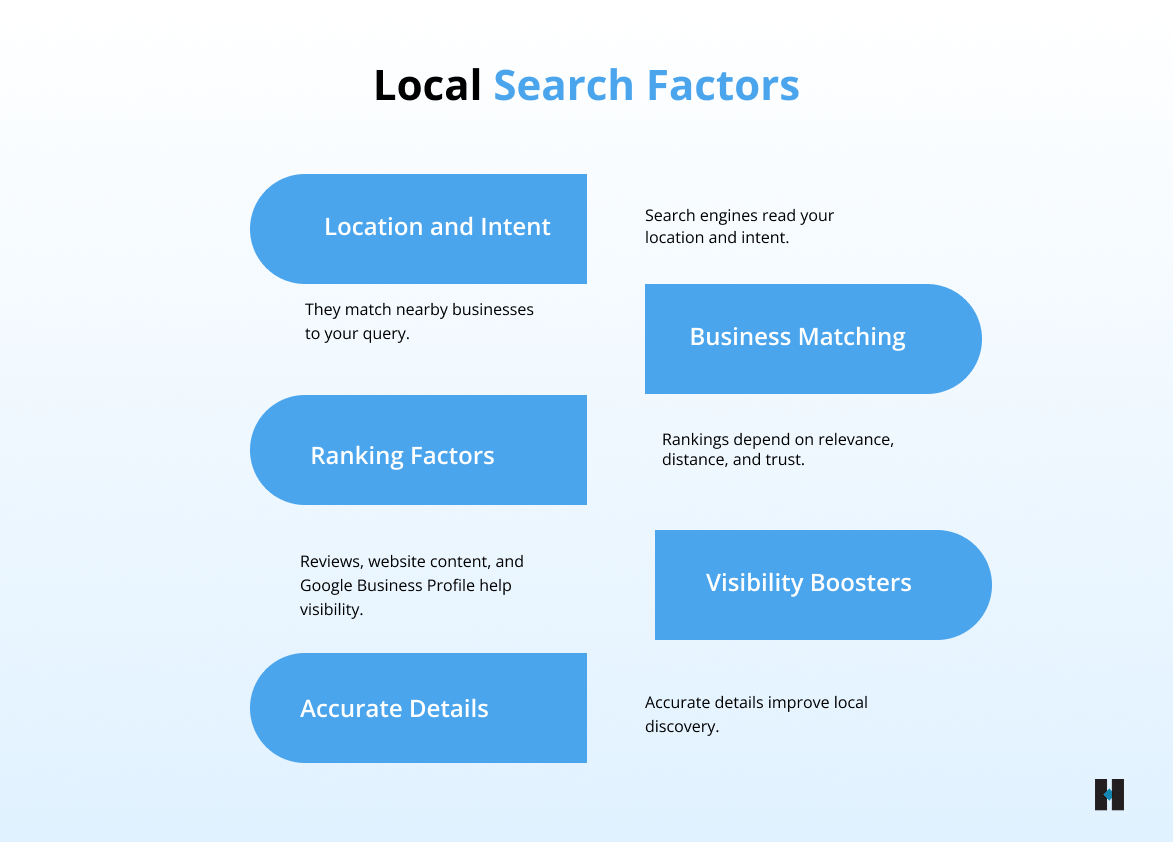
When someone searches for a local business, Google does not rank results randomly. Google says local results are mainly based on relevance, distance, and prominence. Relevance means how well a Business Profile matches the search. Distance refers to how far the business is from the searcher or searched location. Prominence refers to how well-known and trusted a business appears, based on information such as links, reviews, ratings, and other signals.
This is important because many business owners assume local ranking is only about being closest to the searcher. Distance matters, but it is not the only factor. A business that is slightly farther away can still appear higher if Google believes it is more relevant and more prominent for the search.
For example, if someone searches for “custom furniture store near me,” Google may show a business with detailed service information, strong reviews, complete profile details, relevant product pages, and clear local signals over a closer competitor with a weak online presence.
This is why local SEO cannot rely on location alone. Your business needs to clearly communicate what it offers, where it serves customers, why people trust it, and how customers can take the next step.
Common Challenges Local Businesses Face Online
Local businesses often know their customers well, but they struggle to turn that understanding into a strong online presence. The issue is usually not a lack of quality service. It is that customers cannot easily find, understand, or trust the business when they search online.
1. Incomplete or outdated business information
Many local businesses have old phone numbers, incorrect business hours, outdated addresses, or missing service details across Google, directories, and social platforms. Even small inconsistencies can create confusion. If a customer is unsure whether your business is open, where you are located, or how to contact you, they may move to a competitor.
2. Weak or unclear website content
A lot of local business websites explain very little beyond basic contact information. The homepage may say what the business is, but not clearly explain the services, service areas, process, pricing approach, or reasons to choose them. Customers need enough information to feel confident before calling, booking, or requesting a quote.
3. Poor Google Business Profile optimization
For many local businesses, the Google Business Profile is the first impression. If the profile has limited photos, missing services, weak descriptions, no updates, or unanswered reviews, it may not build enough trust. A well-maintained profile can improve visibility and help customers take action faster.
4. Inconsistent review generation
Reviews influence how customers compare local businesses. The challenge is that many businesses only ask for reviews occasionally, instead of having a consistent process. A competitor with recent, detailed, and positive reviews can look more active and reliable, even if both businesses offer similar service quality.
5. Competing against larger or more visible brands
Local businesses often compete with franchises, directories, marketplaces, and larger companies with bigger marketing budgets. This makes it harder to stand out. The solution is not to copy them, but to build stronger local relevance through service-specific pages, authentic reviews, local content, and clear trust signals.
6. Generic content that does not match local intent
Many businesses publish broad blog posts that do not answer real customer questions. Content like “Benefits of Hiring Professionals” is too generic. Local businesses need content that connects with actual buying decisions, service concerns, seasonal needs, and location-based searches.
7. Weak mobile experience
Most local searches happen when people want quick answers. If the website is slow, hard to navigate, or the phone number is difficult to tap, customers may leave. A local business website should make it easy to call, book, get directions, or request a quote from a mobile device.
8. Not tracking real business outcomes
Some businesses only look at rankings or website traffic. But local SEO should be measured by calls, form submissions, direction requests, bookings, store visits, and quote inquiries. Without tracking these outcomes, it becomes difficult to know which efforts are actually bringing customers.
How Local SEO Turns Visibility Into Business?
Local SEO works best when visibility leads to action. Ranking is useful, but the real goal is not simply to appear. The real goal is to get the right customer to call, book, visit, request a quote, or make a purchase.
That means every part of your local SEO strategy should reduce friction.
Your phone number should be easy to find. Your address should be accurate. Your services should be clearly explained. Your website should work well on mobile. Your reviews should create confidence. Your contact form should be simple. Your business hours should be updated. Your photos should reflect the real customer experience.
For example, a customer comparing three local clinics may choose the one with clear service pages, recent reviews, provider information, visible hours, insurance details, and easy appointment booking. Search visibility created the opportunity, but trust signals won the inquiry.
This is the practical value of local SEO. It connects online visibility with real customer action.
How Should Local Businesses Begin Their SEO Strategy?
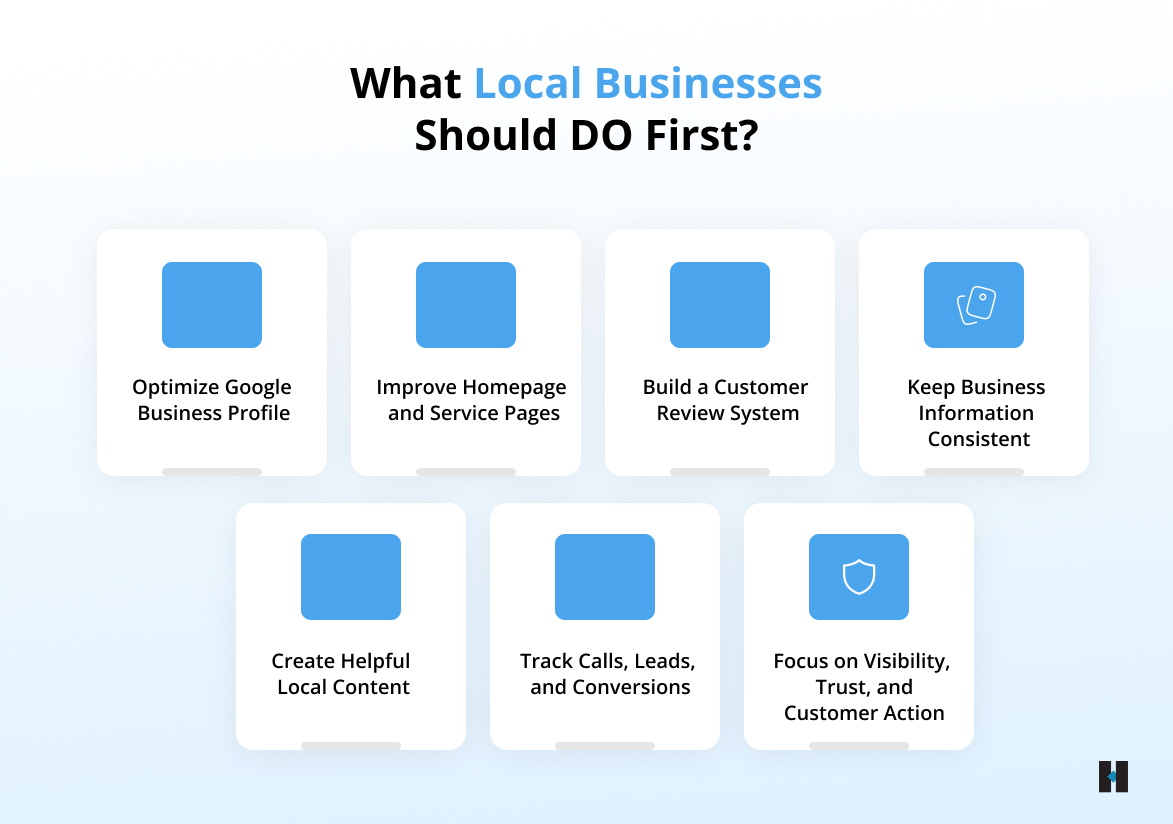
A local business does not need to do everything at once. The best approach is to start with the highest-impact actions that improve visibility, trust, and customer inquiries.
1. Complete your Google Business Profile
Claim and fully optimize your Google Business Profile. Make sure your business name, category, address, phone number, website, hours, services, and photos are accurate. This is often the first place customers see your business in local search.
2. Improve your core website pages
Your homepage should clearly explain who you help, what you offer, where you operate, and how customers can contact you. Your service pages should go deeper and explain each important service in a clear, useful way.
3. Build a review system
Reviews are one of the strongest trust signals for local businesses. Ask satisfied customers for honest feedback and respond professionally to both positive and negative reviews.
4. Check business information consistency
Your business details should match across your website, Google Business Profile, directories, social profiles, review platforms, and local listings. Inconsistent phone numbers, addresses, or hours can confuse both customers and search engines.
5. Create useful local content
Publish content that answers real customer questions. Focus on topics related to your services, customer concerns, seasonal needs, buying decisions, and local search intent.
6. Track real business outcomes
Do not measure local SEO only by traffic. Track phone calls, website visits, direction requests, search queries, form submissions, appointment bookings, quote requests, and conversions.
Local SEO works best when every action supports the same goal: helping nearby customers find your business, trust your business, and take the next step.
Common Local SEO Mistakes to Avoid
Many local businesses struggle with local SEO because the basics are either incomplete, inconsistent, or not aligned with how customers actually search.
1. Vague homepage content
Your homepage should clearly explain what services you offer and which areas you serve. If visitors or search engines cannot quickly understand your business, your local visibility can suffer.
2. Ignoring Google Business Profile
Many businesses set up their Google Business Profile once and then stop updating it. Your profile should stay active with accurate hours, services, photos, updates, and review responses.
3. Inconsistent review collection
Reviews build trust and influence local buying decisions. Asking for reviews only occasionally can slow down reputation growth and make competitors appear more credible.
4. Targeting broad keywords
Local businesses should focus on location-based intent, not only broad keywords. A term like “roof repair near me” is usually more valuable than a generic term like “roof repair.”
5. Creating thin location pages
Location pages should not use the same copy with only the city or area name changed. Each page should include useful, specific information for customers in that service area.
6. Not updating business details
Old phone numbers, incorrect hours, outdated addresses, or mismatched listings can confuse customers and reduce trust. Consistency across your website, Google profile, and directories is essential.
7. Publishing generic blog content
Blog content should answer real customer questions. Generic posts that do not connect with local problems, services, or buying decisions rarely support meaningful SEO growth.
8. Expecting instant results
SEO is not like turning on a paid ad campaign. Google’s documentation explains that changes can take time to appear in search results. Some updates may show quickly, while others can take several months.
Local SEO works best as a long-term system. Your website, Google Business Profile, reviews, content, citations, and reputation all become stronger together over time.
How tecHindustan Helped a Local Business in Austin Strengthen Its Local SEO Presence?
One of our clients, a local home services company in Austin, Texas, was facing a common challenge that many US-based local businesses experience. The company had a strong service team, reliable customer support, and a good reputation among existing customers, but its online visibility did not reflect the quality of its work.
The business offered high-value services such as repairs, installations, maintenance, and emergency support across multiple nearby service areas. However, its website was not structured to capture local search demand properly. The homepage explained the business in general terms, but the core services did not have strong dedicated pages. Its Google Business Profile had limited service details, few recent photos, and inconsistent updates. Reviews were positive, but there was no clear system for generating new customer feedback.
tecHindustan approached the project with a clear goal: to improve the client’s local visibility, strengthen customer trust, and increase qualified inquiries from people actively searching for their services.
The first step was to optimize the client’s Google Business Profile with accurate categories, service areas, business hours, service descriptions, photos, and regular updates. This helped the business present itself more clearly in local search and Google Maps results.
Next, we improved the website structure by creating focused service pages for the client’s key offerings. Each page was written to answer practical customer questions, such as what the service includes, when the customer may need it, what areas are covered, and how to request an estimate.
We also helped the client build a more consistent review-generation process. Satisfied customers were encouraged to share honest feedback, while the business responded professionally to reviews to build trust with future customers.
Along with this, we reviewed business information across key directories and local listings to ensure the name, address, phone number, website, and service details were consistent everywhere.
The result was a stronger local SEO foundation that helped the business become easier to find, easier to trust, and easier to contact. For local businesses in competitive US markets, this is where SEO creates real value: not just higher rankings, but better visibility in the moments when customers are ready to call, book, or request a quote.
Final Thoughts
Search engine optimization for local businesses is about making your business easier to find, understand, and trust when nearby customers are actively looking for the products or services you offer.
For most customers, the decision begins before they call, visit, book, or request a quote. They review your Google Business Profile, website, services, photos, ratings, location details, and customer reviews to decide whether your business is credible and relevant to their needs.
This is why local SEO is more than a visibility tactic. It helps your business appear at the moment when a potential customer has a clear need and is ready to take action.
Businesses that perform consistently in local search usually focus on the fundamentals. They maintain accurate business information, create useful location-based content, improve their website experience, earn genuine reviews, and make it simple for customers to contact or visit them.
tecHindustan helps local businesses strengthen their search presence through local SEO strategy, Google Business Profile optimization, website improvements, content, technical SEO, and performance tracking. Our approach focuses on helping businesses attract relevant local searches and turn that visibility into calls, inquiries, bookings, and store visits.
Ready to improve your local search visibility and reach more customers in your area? Contact tecHindustan to discuss a practical local SEO strategy built around your business goals.
FAQs
