

According to research, businesses that use multichannel marketing see a 9.5% increase in revenue compared to those relying on a single channel. Insightful. Isn’t it?
Having said that, multichannel marketing requires careful scrutiny to understand how to optimally utilize multiple digital channels and align them with your business goals.
Moreover, a deep and detailed analysis is crucial to know whether or not your business needs one to boost its growth and presence. So, go on to read interesting insights and findings on how you can leverage multichannel marketing for your business.
What is Multichannel Marketing and Why Does It Matter?
Multichannel marketing is about expanding the branches of a business to all possible platforms, whether it’s email, social media, websites, mobile apps, and so on. The ideology and intent behind it are to build the brand presence wherever the audience can be.
In a sense, it’s like aiming your darts at all the right boards, using different platforms.
Result?
Your brand visibility increases, customers get a chance to connect the dots (from different platforms), and move to a greater degree of trust. Your business gets more chances and spots to connect with the audience. The overall engagement rate improves, and you’re able to create an omnipresent experience for your brand.
Why Multichannel Marketing Is Effective?
Instead of waiting for the customer to discover and visit a single platform, it’s a hundred times better to maintain a ubiquitous brand presence.
It helps reach them from the spots where they are already spending their time. Say, for instance, a potential customer spends most of their time on the platform like Instagram. Instead of pulling their attention to the platform where he is unlikely to visit, it’s better to catch his attention right there and then.
It’s not just about broadcasting. It’s about orchestrating the right messages across the right channels at the right time.
Why it Works:
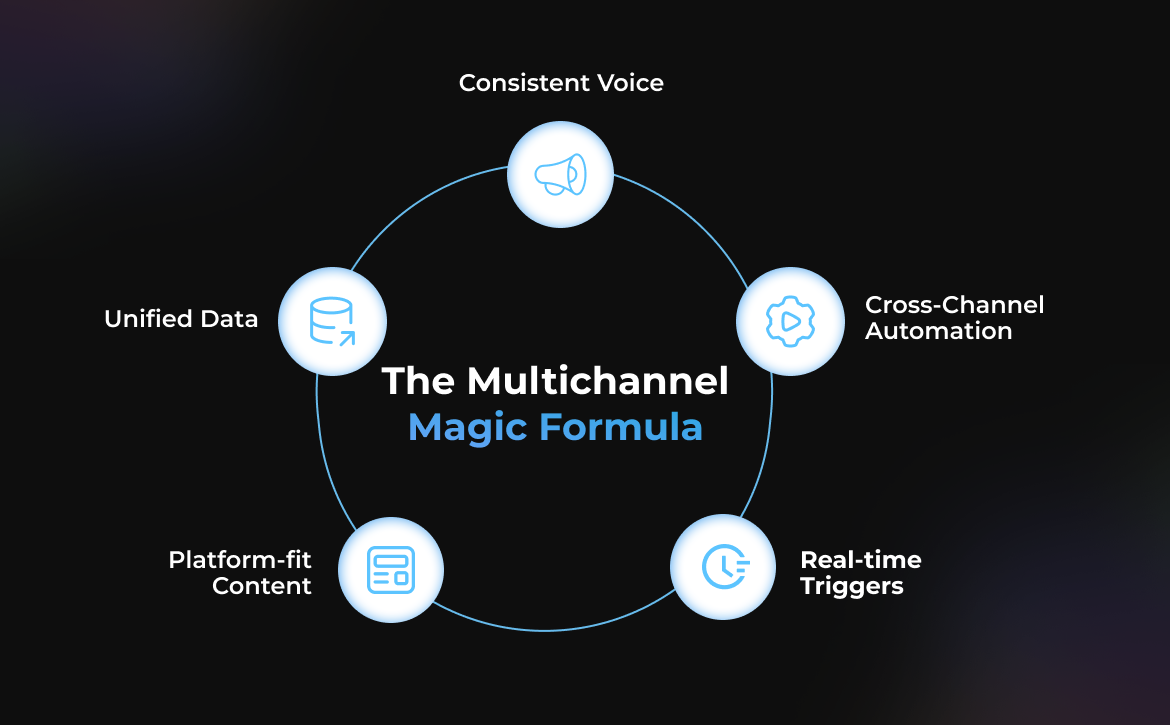
- Consistent Brand Voice Across Platforms:
Your audience sees the same values, tone, and messaging no matter where they interact with your brand, building familiarity and trust.
- Cross-Channel Automation:
Tools like Klaviyo, MoEngage, or HubSpot help you automate flows across platforms. So, if someone engages on WhatsApp, they might receive a follow-up email or SMS based on their behavior.
- Real-Time Behavior Triggers:
Campaigns can respond to actions in the moment. For example, if a user clicks a link in your email but doesn’t purchase, a reminder can be sent via push or SMS within minutes.
- Content That Fits the Channel:
Each platform has its own language. Use short, visual content for social media, detailed storytelling in emails, and quick updates or offers on SMS.
- Unified Data for Personalization:
When your data is synced across platforms, you can personalize your message with better accuracy, sending the right product, offer, or message to the right person.
Find out if Multichannel Marketing is the Right Fit for Your Business
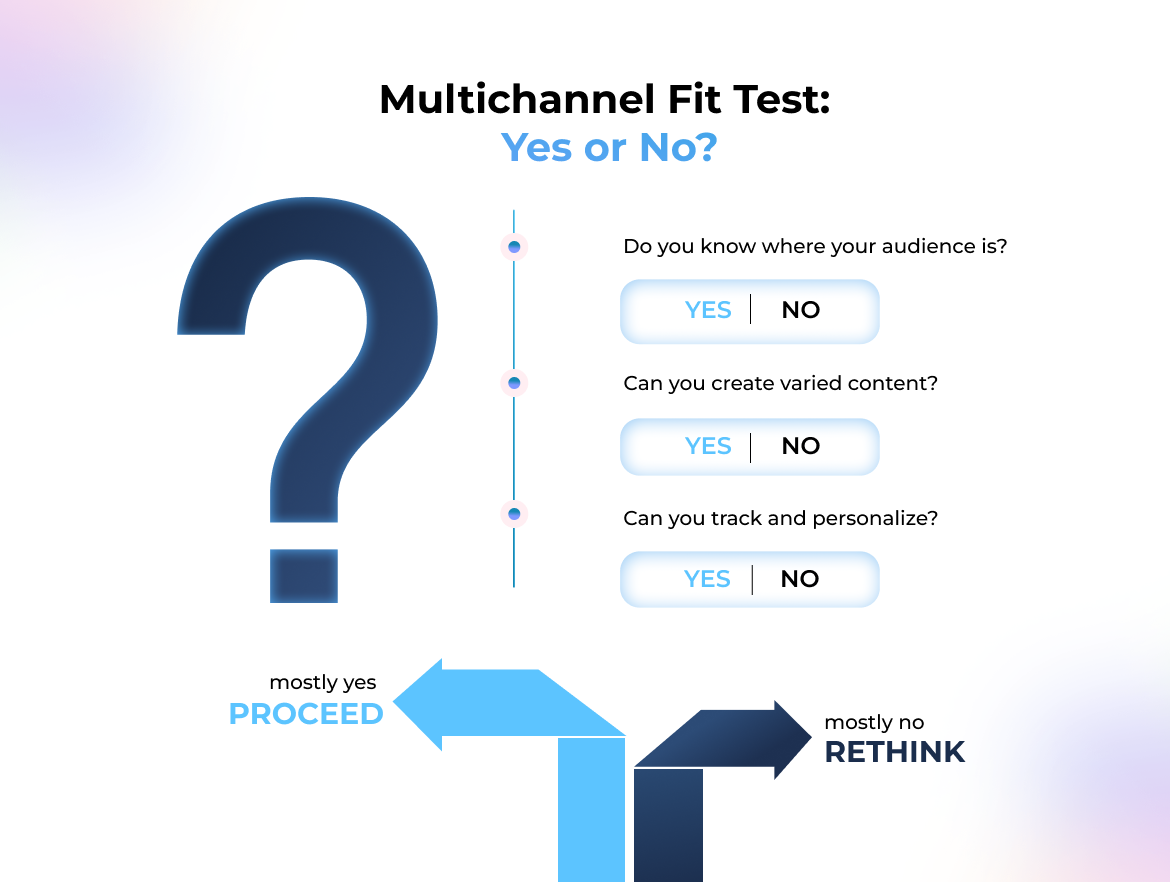
Multichannel marketing is not recommended for every business type. If you think turning on the volume on every channel (online marketing in particular) will get you the clients, you are missing the point.
Here is a specific set of questions that you must ask yourself before opting for multichannel marketing:
- Do I know where my customers spend their time online?
- Do I have enough content variety to speak to them on different platforms?
- Can I track performance across email, social, ads, and web?
- Am I ready to personalize messages based on where they are in the journey?
If the answer is yes, you’re ready to build a marketing engine that meets people where they are and guides them to where you want them to go.
On the contrary, if you are into niche B2B Services With Long Sales Cycles, Local-Only Businesses with low online engagement, bootstrapped startups with limited resources, or Single-Product, One-Time Purchase Brands (High-end furniture, expensive jewelry, real estate), multichannel is not your thing.
It’s better to save your resources for more focused strategies that prioritize depth over reach.
Common Multichannel Marketing Mistakes We Made (And What They Taught Us)
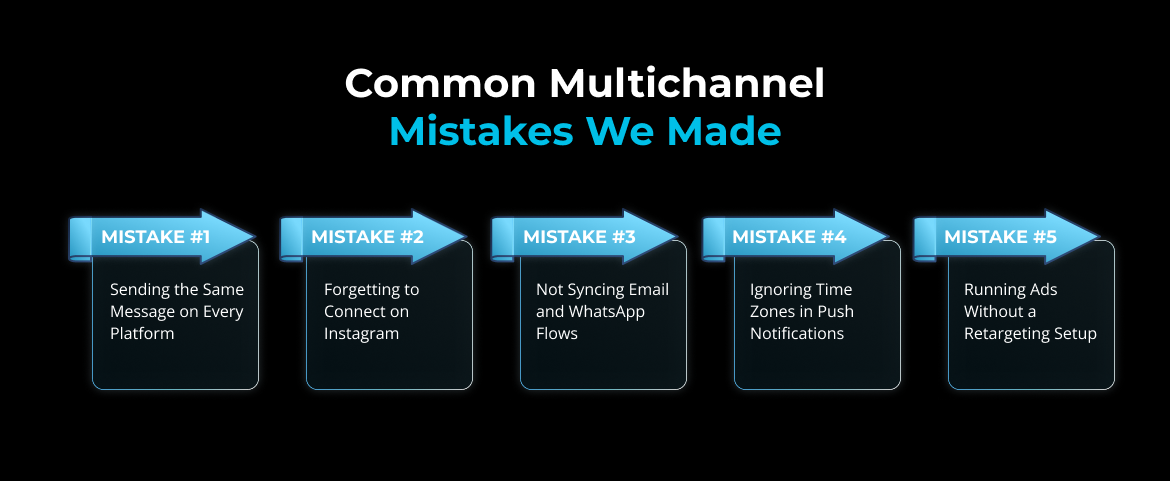
Mistake #1: Sending the Same Message on Every Platform
At one point, we were using the exact same message across email, Instagram, and WhatsApp. It felt efficient. After all, consistency is important, right?
But things started falling apart when we handled a product launch campaign for one of our retail clients. We created a single promotional message and pushed it across all channels: email subscribers, Instagram followers, and WhatsApp opt-ins, all at the same time, with the same copy and visuals.
The results?
- Email open rates dipped below average, and unsubscribe rates went up slightly.
- Instagram engagement was flat, with fewer likes and barely any comments.
- WhatsApp replies included things like “Already saw this on Instagram” or “Why are you repeating this?”
That was our lightbulb moment.
We realized that although the message was consistent, it wasn’t context-aware. What sounds friendly and casual on Instagram feels overly informal in email. And what’s urgent on WhatsApp may feel pushy when repeated in a static post. Our audience wasn’t responding because we weren’t respecting the nuances of each platform.
What changed:
We started customising our content based on the platform. Emails became deeper and more story-driven. Instagram focused on visuals and community. WhatsApp updates became shorter, more direct, and time-sensitive. That shift alone improved our engagement across the board.
What we learned:
Consistency doesn’t mean copy-paste. It means staying on-brand while speaking the language of each platform.
Mistake #2: Forgetting to Connect on Instagram
For a long time, we treated Instagram like a digital brochure where we had clean posts, curated grids, and no interaction. It looked good, but felt cold. We expected conversions without conversations, forgetting that social media is meant to be, well, social.
The turning point came during a campaign for a D2C skincare client. We launched a month-long content series with great visuals, product photos, and consistent branding. But despite sticking to the calendar, engagement was flat. No comments, minimal DMs, and the save/share count was low.
We thought maybe it was the timing or the algorithm. But when we checked the client’s tagged posts and stories, we saw something telling: people were talking about the brand, but not to the brand. They were posting testimonials, unboxing videos, and feedback in their own stories, but we weren’t replying, resharing, or even acknowledging them.
That’s when it clicked. We weren’t creating space for interaction; we were just publishing content and hoping it performed. Instagram wasn’t the problem. Our one-way strategy was.
What changed:
We started showing up in stories, posting behind-the-scenes reels, and using polls and Q&As to involve the audience. We reshared user-generated content, replied to every DM, and even started a live AMA series. The difference was immediate, engagement doubled, and followers started turning into customers through conversation, not just clicks.
What we learned:
Instagram doesn’t reward perfection; it rewards presence. If you show up as a real brand, not just a pretty feed, people will show up for you in return.
Mistake #3: Not Syncing Email and WhatsApp Flows
We had email and WhatsApp campaigns going strong, but they were running in silos. On the surface, everything looked efficient. But the cracks showed up quickly.
During a launch campaign for a wellness brand, a new user received a 10% coupon via WhatsApp after signing up. Two days later, they got the exact same coupon via email. One replied, “Already used this,” and another unsubscribed altogether. That was the wake-up call.
When we looked deeper, we found overlapping journeys, duplicate messaging, and no continuity. People weren’t confused because we were marketing too little. They were confused because we weren’t coordinating enough.
What changed:
We mapped the user journey end-to-end and synced our platforms. A WhatsApp click led to a context-aware email. If a user didn’t engage on one channel, the next message picked up the thread, not repeated it. Everything felt smoother—more like a conversation, less like a broadcast.
What we learned:
When your channels work in silos, your message feels scattered. Integration builds trust and gives your users a sense that someone’s actually paying attention.
Mistake #4: Ignoring Time Zones in Push Notifications
We used to schedule push notifications based on our time, not theirs. At 11 AM IST, we’d hit send thinking it was peak hours—only to find U.S. users getting pings at 1 AM. Engagement was dead, and we kept blaming the format.
Then, during a global promo, a frustrated user replied, “Love the deal, but please stop waking me up with these.” That’s when we realized we were treating time like a technical detail, not a user experience.
What changed:
We started segmenting by geography and scheduling notifications based on users’ local time zones. We also tweaked the message timing by behavior—some users preferred evening nudges, others clicked in the morning.
What we learned:
A good message at the wrong time is still a miss. Timing alone won’t fix your strategy, but the right timing can amplify it.
Mistake #5: Running Ads Without a Retargeting Setup
In one early campaign for a SaaS client, we ran awareness ads with solid copy and creative. Traffic came in, but no one converted. And that was it. No follow-up, no reminders, no retargeting funnel. Just silence.
A week later, we reviewed the analytics. Hundreds of visitors had bounced from the pricing page. They were interested, but we hadn’t stayed with them. That’s when we realized we weren’t losing because the ads were bad; we were losing because they were forgettable after first contact.
What changed:
We added pixel tracking, created retargeting audiences, and ran tailored reminder ads for users who visited key pages. The impact was instant. Familiarity kicked in, clicks rose, and conversions finally followed.
What we learned:
The second impression often closes the sale. Retargeting isn’t optional; it’s the digital equivalent of following up after a great pitch.
How We Helped Brands Scale Through Multichannel Marketing (Real Client Wins)
We learnt our lessons and moved towards building a solid online presence for our clients. At tecHindustan, we’ve worked hands-on with diverse clients to turn scattered efforts into streamlined, revenue-driving strategies.
Here’s how we’ve helped real brands unlock real growth:
Case Study 1: Healthcare Brand
One of our healthcare clients was facing a problem, which was that his website pulled high traffic but was struggling with poor conversion rates. We built a multichannel strategy using:
- Instagram reels for product storytelling
- WhatsApp for cart abandonment follow-ups
- Email drip campaigns for education
- Retargeting ads on Meta and Google
The results were remarkable. There was a 2.3x increase in conversions, a steep 34% rise in repeat purchases, and a straight 50% drop in bounce rate. And the note we received from our client?
“It felt like our brand finally had a voice across the customer journey. Every message matched the moment.” — Founder
Case Study 2: Healthcare and Wellness Brand
Another client dealing in Healthcare and wellness brands came to us with a problem of low trial-to-paid conversions. As per his report, very few users who start a free trial of his product end up becoming paying customers. We dug deeper into the scenario and deployed:
- LinkedIn ads for top-funnel education
- Email for onboarding flows
- Chatbot for website engagement
- SMS nudges for trial reminders
The results stunned us all. A trial-to-paid conversion increased by 45%. Demo show-up rate was improved by 31% and customer retention jumped within the first 30 days.
How Global Brands Leverage Multichannel Marketing
Successful global brands don’t just show up everywhere. They show up with intent. Their strength lies in delivering contextual, platform-specific experiences that guide users from awareness to action with minimal friction.
Let’s break it down:
- Nike builds hype around product launches by syncing efforts across email campaigns, Instagram ads, mobile push notifications, and exclusive in-app events. Each channel plays a distinct role. Email builds anticipation, social creates buzz, push notifications drive urgency, and the app delivers exclusivity.
- Zomato keeps users coming back daily through a mix of SMS offers, witty email content, timely push alerts, and engaging Instagram stories. It’s not about overwhelming users. It’s about staying top of mind through value-driven nudges sent at the right moment.
- Amazon excels at cross-selling by using search ads, personalized display ads, segmented emails, and voice prompts through Alexa. Their strategy is rooted in user behavior, allowing them to recommend products that feel timely and relevant.
What these brands get consistently right is contextual storytelling across channels. They adapt their messaging based on:
- Where the customer is in the buying journey
- Which platform is the customer using
- What actions has the customer already taken
This personalized approach makes the experience feel cohesive and aligned with customer intent. It also explains why their multichannel efforts lead to higher engagement and stronger conversions.
Here’s a quick cheat sheet we built for ourselves after running dozens of multichannel campaigns. Feel free to steal it.
| Channel | Best For | Avoid This | Pro Tip |
|---|---|---|---|
| Long-form storytelling & offers | Generic subject lines | Personalize the first 3 words | |
| Visual branding & engagement | Treating it like a flyer board | Use stories for polls & Q&As | |
| Time-sensitive offers, support | Blasting bulk messages | Keep it 1:1 and short | |
| Push Alerts | Flash updates, reminders | Bad timing | Segment by time zone |
| Paid Ads | Cold to warm conversion | No retargeting | Use emotion + urgency |
Multichannel Works Best When Everything Talks to Each Other
At its heart, multichannel marketing isn’t just about being present everywhere; it’s about showing up with purpose, with empathy, and with intent.
The strategies we’ve shared here weren’t just lessons in marketing. They were moments of truth when we realized that audiences aren’t looking for more messages; they’re looking for meaningful interactions. And when brands stop broadcasting and start listening, engagement stops feeling forced. It becomes natural.
Multichannel marketing works not because it’s loud, but because it’s layered, relevant, and well-timed. When email talks to WhatsApp, when Instagram backs up your SMS, when your ads follow up without being intrusive, that’s when you stop looking like a brand that’s trying too hard and start becoming one that’s simply part of the customer’s world.
So if you’re thinking about where to begin, start here:
- Show up where your customers already are.
- Speak in the language of the platform.
- Make each touchpoint feel like a continuation, not a repetition.
Because growth today isn’t about picking the best channel. It’s about connecting them all with intention. And when that happens, your message doesn’t just reach. It resonates.
If you are looking for an expert resource to do it for, we are right here. Reach out to us, and we’ll help you scale multichannel strategies that actually convert and not just collect impressions.
